
TRL Async GRPO Can Sync LoRA Adapters Instead of Full Weights
TRL v1.14 adds adapter-only vLLM sync for AsyncGRPOTrainer, making distributed RL training less dependent on shared GPUs and full-weight transfers.
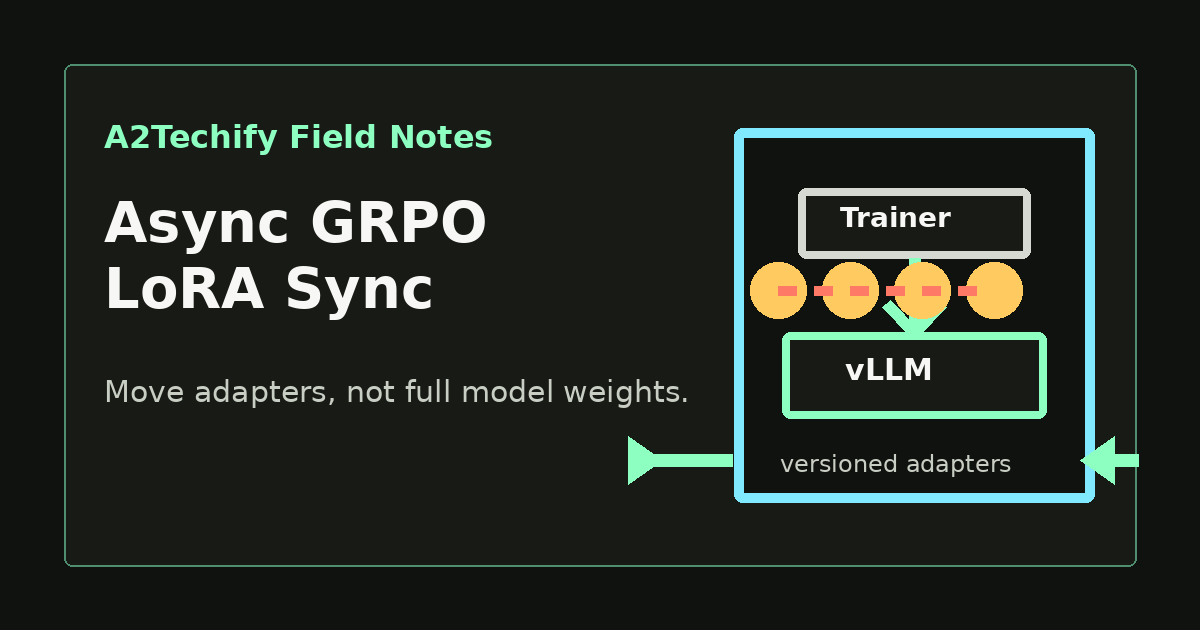
Hugging Face’s TRL v1.14 picked up a practical systems improvement for reinforcement learning fine-tuning: AsyncGRPOTrainer can train a LoRA adapter and sync only that adapter to vLLM instead of pushing the whole model after every update.
That sounds like a narrow training detail, but it changes the shape of the system. A full model sync can mean moving gigabytes at every policy update. A rank-1 LoRA adapter for a 1.5B model can be only a few megabytes, which means the trainer and the inference workers no longer have to behave like one tightly coupled GPU box.
What Changed
TRL’s asynchronous GRPO trainer already separated rollout generation from training. A background rollout worker asks a vLLM server for completions while the training loop consumes scored samples and updates the policy. The new piece is adapter-only synchronization when the trainer is using PEFT LoRA and the vLLM server is running with LoRA support.
Instead of merging the adapter into the base model and transferring the full weight set, the trainer saves a versioned adapter directory and asks vLLM to load it through the runtime LoRA API. The Hugging Face write-up describes the feature as shipping with TRL v1.14, backed by PR #7017.
The reference deployment is intentionally concrete:
- One trainer Job runs
AsyncGRPOTrainerwith LoRA. - Two vLLM Jobs serve the base model plus dynamically loaded adapters.
- A Hugging Face Storage Bucket is mounted into every Job at the same path.
- A small proxy adds auth, routes rollouts, and broadcasts adapter loads to every replica.
The result in the Hugging Face post is not just cleaner architecture. Five measured runs took the same 500-step recipe from 3 hours 27 minutes down to 53 minutes as the setup improved.
Why We’re Paying Attention
Small teams usually hit RL fine-tuning friction in the plumbing before the math. Generation wants fast inference. Training wants optimizer memory and stable checkpoints. Weight sync wants a low-latency path between them. If all of that has to fit on one node or one cluster filesystem, experiments get expensive quickly.
Adapter-only sync is useful because it lowers the coordination cost. It does not make GRPO cheap, and it does not remove the need for GPUs, reward design, or careful evaluation. It does make the boundary between trainer and inference workers less brittle.
The pattern is also broader than Hugging Face Jobs. The important idea is this:
Keep the base model fixed on inference workers.
Publish small, versioned adapters from the trainer.
Load adapters at runtime on the serving side.
Keep old adapter versions available while in-flight rollouts finish.
That is the kind of systems trick that matters when a research workflow starts becoming an operating workflow.
How It Works
AsyncGRPOTrainer overlaps two loops. The rollout side generates samples from the current or recently current policy. The training side computes updates from samples that are not too stale. The max_staleness setting controls how far behind a sample can be before the trainer discards it.
With LoRA enabled, each weight sync publishes a new adapter name such as trl-policy-v7. That versioning matters. vLLM’s prefix cache depends on the adapter identity, so reusing one adapter name while changing the underlying weights can mix cached key-value blocks from one policy with decoding under another policy. Versioned adapter names avoid that class of bug.
The serving side needs enough adapter slots to keep the current policy and still serve rollouts that started under older allowed versions. The Hugging Face example uses max_staleness=4, so the vLLM servers are launched with room for the current adapter, the four previous adapters, and one extra slot during the swap.
VLLM_ALLOW_RUNTIME_LORA_UPDATING=1 \
VLLM_SERVER_DEV_MODE=1 \
vllm serve Qwen/Qwen2.5-Math-1.5B \
  --enable-lora \
  --max-lora-rank 1 \
  --max-loras 6 \
  --max-model-len 4096 \
  --logprobs-mode processed_logprobs
On a normal cluster, the adapter path might live on a shared filesystem. In the Jobs example, a Hugging Face Storage Bucket is mounted into every container. The trainer writes adapters into the bucket path, and each vLLM replica reads from the same absolute path when the proxy broadcasts a load request.
A Small Useful Test
This post does not need a sample repo. A realistic reproduction needs Hugging Face Jobs, GPU-backed vLLM servers, mounted storage, and the right TRL/vLLM versions. A tiny repo would either hide the hard parts or require paid cloud compute to prove anything meaningful.
A better first test is a dry architecture check before launching a run:
Model: Does vLLM support LoRA for the base model?
Adapter: Is the LoRA rank at or below --max-lora-rank?
Sync mode: Does the trainer log adapter-only vLLM sync instead of merged sync?
Storage: Can every worker read the same adapter path?
Versions: Are adapter names immutable and versioned?
Slots: Is --max-loras at least max_staleness + 2?
Rollouts: Can older in-flight policy versions finish before unload?
Proxy: Are load, unload, pause, and resume broadcast to every replica?
Metrics: Do trainer/server importance ratios stay near 1?
If any answer is fuzzy, fix that before spending GPU hours. The failure modes here are subtle: silently serving the base model under an adapter name, evicting a still-needed adapter, or breaking cache correctness by changing weights behind a reused model name.
Cost And Operational Notes
The feature reduces synchronization traffic; it does not make asynchronous RL a free-tier workflow. Hugging Face Jobs require a positive credit balance, and GPU flavors are billed for the time they run. Storage Buckets are mutable object storage with their own pricing and lifecycle considerations.
There are also version and security details to keep straight:
- The TRL docs currently call the async trainer experimental and require recent
vllmandtransformersversions. - The Hugging Face recipe pins vLLM because runtime LoRA endpoints and flags move quickly.
- vLLM documents runtime LoRA loading as powerful but security-sensitive; keep it inside a trusted training environment.
- Storage Buckets are mutable and not Git-versioned, so checkpoints and adapters need explicit naming and cleanup rules.
- Data-parallel serving needs careful broadcasting. Loading an adapter on only one replica means the same policy name can behave differently depending on routing.
For a small team, the practical starting point is not a full multi-Job training system. First prove that your reward function is stable, your dataset is worth RL, and a small single-server run improves the target metric. Use the adapter-only pattern when sync cost and rollout throughput become the bottleneck.
What We’d Watch Next
The next useful step is making this pattern easier to operate outside hand-built research setups. Teams will need boring answers for adapter lifecycle, proxy health, replica consistency, preemption recovery, and cost ceilings.
It is also worth watching whether adapter-only sync becomes the default mental model for RL fine-tuning. Full-weight transfer still has a place, especially when the trained changes cannot be served as a plain LoRA adapter. But when LoRA is enough, moving megabytes instead of gigabytes is the kind of practical win that compounds.
The takeaway is simple: if your GRPO setup is bottlenecked on policy sync, check whether you can keep the base model fixed and move only versioned adapters.